


Welcome to the dedicated Executive Summary for our 2023 Identity Threat Report. Here we've brought together the bullet-list style summary that opens the full report, as well as a few curated selections and charts to get immediately to the "what do I need to know" of it all.
And of course, if you want to dive into the details and the "why" and "how" behind today's threats to identity, you can jump over to the full report, or download the PDF (https://www.f5.com/labs/articles/threat-intelligence/2023-identity-threat-report-the-unpatchables). Both of them are one click away - we hate walling off content as much as you hate giving fake info just to read a report.
Executive Summary
- Threats to digital identities are continuous in nature, widespread in targeting, and progressive in their evolution.
- The average proportion of credential stuffing in unmitigated traffic for sampled organizations across all sectors was 19.4%.
- Post-mitigation, the average rate of credential stuffing was 6.0%.
- Mobile endpoints generally see higher rates of automation pre-mitigation than web endpoints.
- Travel, telecommunications, and technology firms experienced higher credential stuffing rates than other sectors.
- While authentication endpoints see higher traffic and automation rates than account management endpoints, account management endpoints serve critical roles for attackers, such as the creation of canary accounts and facilitation attacks for information gain.
- 65% of credential stuffing traffic was composed of unsophisticated HTTP requests with no browser or user emulation.
- Around 20% of malicious automation traffic on authentication endpoints was sophisticated, in that it successfully emulated human behavior on a real browser, including mouse movements and keystrokes.
- Aggregators, which play a significant role in several industries such as finance, can be both a source of noise in terms of detecting malicious automation, as well as a vector in their own right for attackers.
- Many organizations use authentication success rate to identify unwanted automation, but aggregator and canary account traffic can make authentication success rate metrics unreliable.
- The phishing industry has matured, with phishing kits and services driving down the requisite technical expertise and cost.
- Phishing appears to target financial organizations and large-scale/federated identity providers such as Microsoft, Facebook, Google, and Apple the most.
- Reverse phishing proxies, also known as real-time phishing proxies or man-in-the-middle (MITM) phishing, have become the standard approach. These proxies can harvest session cookies and defeat most multi-factor authentication (MFA).
- Detection evasion tools that defeat capabilities such as Google Safe Browsing are also a high priority for phishing.
- Multi-factor authentication bypass techniques have become more common, with successful strategies based on malware, phishing, and other social engineering vectors observed.
- Multi-factor authentication technologies based on public key cryptography (such as the FIDO2 suite of protocols) are significantly more resistant to observed MFA bypass techniques.
Credential Stuffing
Credential stuffing is a numbers game. It hinges on the fact that people reuse passwords, but the likelihood that any single publicly compromised password will work on another single web property is still small. Making credential stuffing profitable is all about maximizing the number of attempts, and that means it is also all about automation.
Prevalence
Quantifying the prevalence of credential stuffing across multiple different organizations is difficult because credential stuffing attacks against a single organization often occur in intense waves, then subside to a lower baseline level for some time. With that said, Figure 1 shows the daily mean proportion (with 95% confidence interval) of malicious automated traffic against the authentication surfaces of 159 customers.
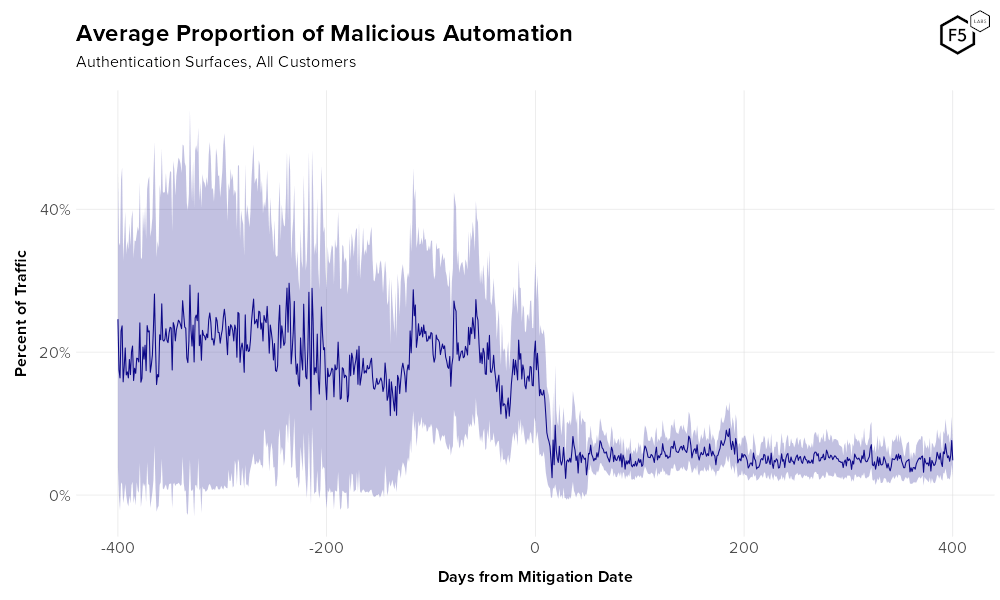
“On average one in five authentication requests comes from malicious automated systems, i.e., credential stuffing bots.
”
Of course, identity-related attacks aren't exclusive to authentication surfaces - in the full report we go much more in depth on different endpoints, as well as comparing platforms and industries.
Want to hear about attackers' tactics, techniques, and procedures? Yep, we cover that as well (canary accounts are especially useful for attackers), but here's a small nugget:
“For unmitigated authentication endpoints, basic, low-sophistication attacks made up 65% of malicious traffic.
”
We also spent a fair amount of time looking into the lifecycle of all these compromised credentials. That's not new for us, of course, but by performing some overlap analysis between known compromised credentials and recently submitted credentials, we were able to come to some surprising conclusions. For one thing, even though we know about a lot of breaches and the creds harvested from them, that only accounts for about a quarter of the credentials that bots are using.
“Three quarters of the stolen credential supply chain is unaccounted for.
”
Phishing
It goes without saying that detecting phishing is difficult, because most of the point of phishing is to be difficult to detect. We recently spoke to a security operations employee responsible for managing a commercial, off-the-shelf email phishing filter who said that their tool has a 95% false positive rate for phishing mails. This means that phishing costs everybody whether they fall for one or not.
We can see which organizations are the most phished by looking at the Anti-Phishing Working Group's data...
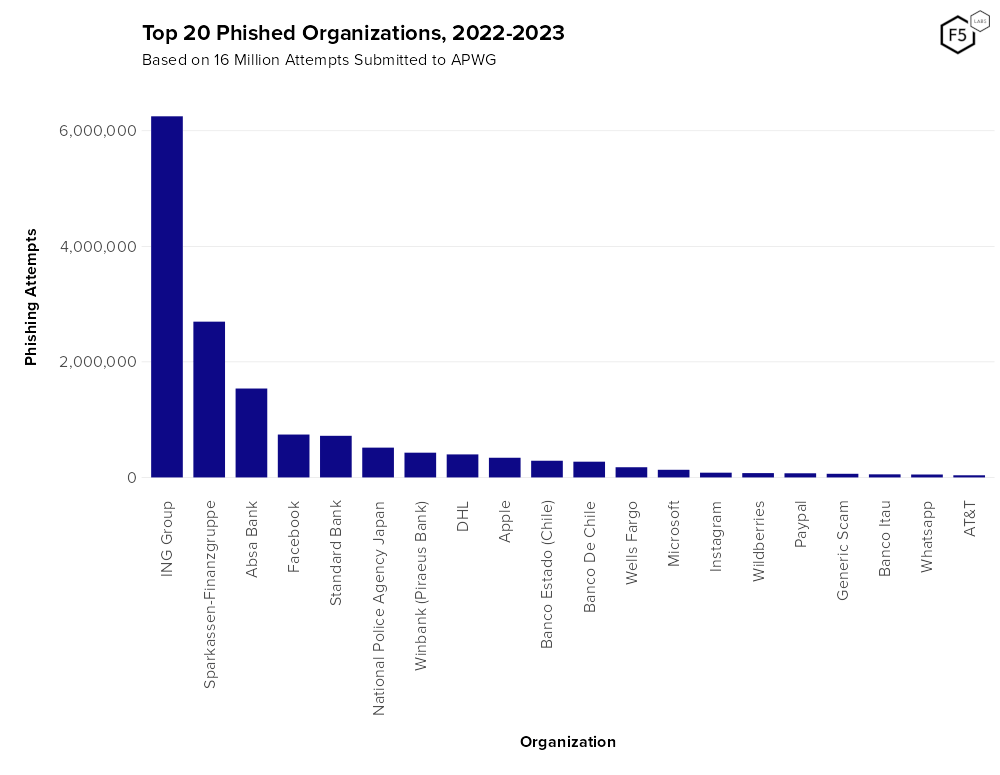
... but to know where attackers want to be, you have to dig into their wish lists on the dark web. Which we did.
- Office 365
- Steam
- Yahoo
- WordPress
- iCloud
- Binance
- Amazon
- Dropbox
- Yandex.ru
- American Express
- Venmo
- GitHub
- Airbnb
- Namecheap
- Okta
Want to get into the weeds on phishing TTPs? Yep, that's in the report too.
Multi-factor Authentication Bypass
For more than a decade, the information security community has touted multi-factor authentication as a way to control identity risk. So of course attackers have been hammering away, and have found a handful of ways to bypass MFA. Phishing reverse proxies, malware, social engineering, and more - while having MFA is still much better than not having it, we are well past the point where you can set up an MFA protocol and call it good.
Over in the full report, we don't just talk about problems; we've got a whole stack of recommendations to mitigate these various identity threats. And because F5 Labs’ mission is to deliver threat intelligence, not to promote products, all of our recommendations are vendor-agnostic, and instead give you practical steps to protect your environment and your customers.
About the authors

F5 Labs Staff
Threat Research Team | F5
The F5 Labs team conducts research and analysis of a wide variety of threats, and draws from decades of expertise to recommend effective strategies and controls to mitigate those same threats.
More research by F5 Labs Staff
Sander Vinberg
Threat Research Evangelist, F5 Labs | F5
Sander Vinberg is a Threat Research Evangelist for F5 Labs. As the lead researcher on the Application Protection Research Series, he specializes in the evolution of the threat landscape over the long term. He holds a master’s degree from the University of Washington in Information Management, as well as bachelor’s degrees in History and African and African-American Studies from the University of Chicago.
More research by Sander Vinberg
Tafara Muwandi
RVP of Data Science | F5
Tafara Muwandi is the SVP of Data Science at F5, and oversees the F5 Labs team.
More research by Tafara Muwandi
Melissa McRee
Sr. Manager, Threat Analytics Reporting (TAR) | F5
Melissa McRee is a Senior Manager for the anti-fraud Threat Analytics Reporting (TAR) team at F5.
More research by Melissa McRee
Yefei Fan
Data Scientist | F5
Yefei Fan is a Data Scientist on F5's Threat Analytics and Reporting team, and occasional contributor to F5 Labs.
More research by Yefei Fan
Amanda Repella
Data Scientist | F5
Amanda Repella is a Data Scientist on F5's Threat Analytics and Reporting team, and occasional contributor to F5 Labs.
More research by Amanda Repella
Adeolu Ogunnoiki
Data Scientist | F5
Adeolu Ogunnoiki is a Data Scientist on F5’s Threat Analytics and Reporting team. He holds a bachelor’s degree with distinction in Computer Science, and a certificate of specialization in Data Science. His role includes creating and presenting customized threat briefings & reports, contributing to and writing articles, and creating tools to aid his data analysis.
More research by Adeolu Ogunnoiki
Maryam Syed
Manager | F5
Maryam Syed is the Manager of the APG Data Science team, and occasional contributor to F5 Labs. She has 7+ years of experience with Machine Learning, statistical modeling, and advanced analytics.
More research by Maryam Syed
Shuang Hao
Data Scientist | F5
Shuang Hao is a Senior Data Scientist on F5’s Threat Analytics and Reporting team. Her current focus at F5 includes delivering comprehensive threat briefings and conducting cool analysis and research for both F5 customers and internal teams.
More research by Shuang Hao